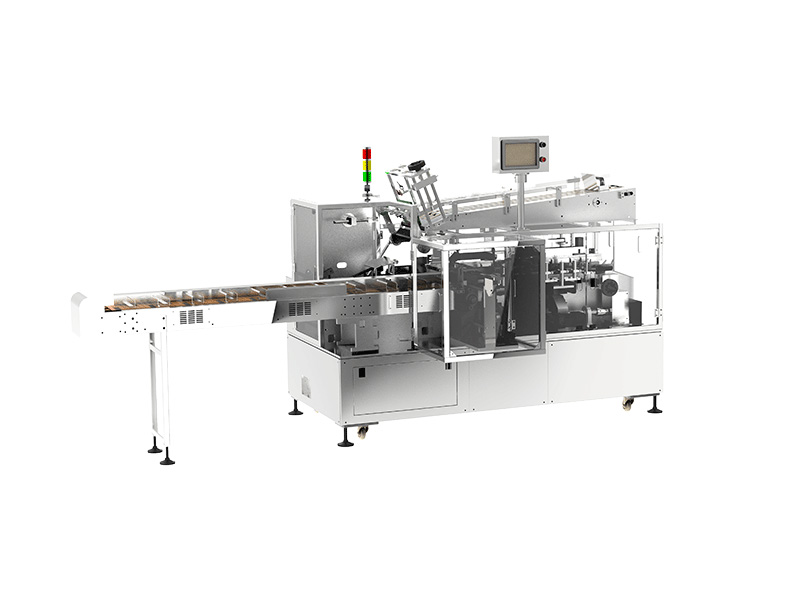
Turnkey Packaging Line: The Work Starts at the Wall, Not the Infeed
A turnkey packaging line is quoted as a list of machines. What decides whether it runs on the day it is switched on is a different document: the plant conditions behind those machines. Supply voltage, installed power, compressed-air flow, floor loading, the width of the access aisle, the space a carton blank trolley needs to turn. Order the five stations separately and what arrives is five condition sheets in five formats, with nobody contracted to total them. Order one scope and that total becomes a deliverable.
If you run a food plant and are weighing one supplier against several, the paragraphs below concern the wall, the floor, and the sheet that ties them together. The machines themselves are covered on the product pages.
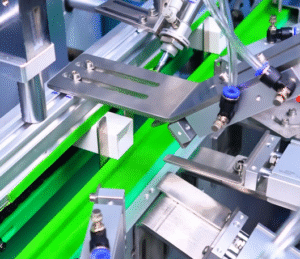
The physical sequence is straightforward. Blanks are erected, product is loaded and the carton closed, cartons are grouped into shipping cases, cases are sealed, and the palletizer stacks them. Conveyors bridge each pair, with one control system reporting the whole run. The sequence is documented on our full-line configuration page as one system.
Now ask each vendor for the conditions their machine needs. One sends a table with voltage and a footprint. Another sends a brochure with a photo and a power figure buried in the text. A third leaves the compressed-air column empty because their standard machine does not use air, and nobody notices that the optional coder on the same station does. None of these documents is wrong. The problem is that a plant does not have five separate supplies. It has one distribution board, one compressor, one floor, and a column grid that was poured years before the project started.
On a multi-vendor project, the work of merging those five sheets into one plant drawing falls to whoever has the time — often your own maintenance lead, in the evenings, during commissioning. That is not a clerical task. It is the design work the project is actually buying.
Before a floor is marked out, one table should exist with a named owner. Here is what it looks like when the published figures on our own product pages are laid out honestly, including the blanks.
| Station | Published supply | Published footprint | Still needed before layout is frozen |
|---|---|---|---|
| Round-bottle labeling (T401) | 220 V | 1,600 × 1,100 × 1,400 mm, about 165 kg | Installed power, whether the fitted coder needs air |
| Servo cartoning (HL-ZC-G1) | 220 V / 50 Hz | 3,300 × 1,250 × 1,700 mm | Installed power, air flow, air pressure |
| Case packing, sealing, palletizing | Not published per station | — | Supply, air, footprint and access for each |
| Plant totals | Breaker capacity, circuit count | Straight-line length plus access on both sides | One signatory for the whole table |
The T401 round-bottle labeling machine publishes ±1 mm placement accuracy and 20–60 containers a minute alongside its supply and footprint. The HL-ZC-G1 servo cartoning machine publishes 50–60 cartons a minute, a carton envelope of L120–200 × W60–140 × H30–70 mm, and its 220 V / 50 Hz supply. Useful figures, all of them. Note what neither page tells you: how many kilowatts the station draws, or how much air it pulls at peak. Those are the two numbers the electrical and compressor sizing depend on, and they are exactly the ones a merged sheet has to capture from the supplier before steel is cut.
Voltage is a starting point, not a load calculation. Breaker sizing needs installed power per station plus a view of which stations start together. Compressor sizing needs peak air flow at the working pressure, not an average over a shift. A line that looks comfortable on five separate condition sheets can still pull more current than the spare circuit carries, or dip the air pressure every time two stations fire together.
The failure mode is familiar to anyone who has been through a commissioning week. Everything runs during the factory test. On site, the line is throttled to a lower rate — not because any machine is faulty, but because the plant cannot feed all of them at once. Someone then buys a second compressor or a new circuit, and the project acquires a cost that was never in the quotation. Neither vendor is responsible for it, because each machine met its own published conditions.
That is the practical case for one scope. Not a promise that the machines are better. A single party that signs the totals.
There is a second cost, quieter than hardware. When each vendor supplies its own conditions, every pair of adjacent stations has to be reconciled against the other: heights, supply points, discharge timing, where a rejected unit exits. With n vendors, the pairs to check are n(n−1)/2, not n−1. Five vendors means ten pairs to reconcile, and each one tends to generate a question, a drawing revision, and a phone call.
Official wage data gives that design work a rate. BLS wage estimates for 2025 put the median for industrial engineers at $49.25 an hour, or $102,440 a year. Applying that rate to the reconciliation hours for a line of this size:
| Vendors on the line | Condition-sheet pairs to reconcile | Engineering hours (illustrative) | Cost of the reconciliation |
|---|---|---|---|
| 2 | 1 | 6 | $295.50 |
| 3 | 3 | 18 | $886.50 |
| 4 | 6 | 36 | $1,773.00 |
| 5 | 10 | 60 | $2,955.00 |
Six hours per pair is an illustrative assumption; swap in the rates and scope that apply at your plant. The table excludes rework on site, which is where a missed pair usually surfaces. What it shows is the shape of the problem: coordination grows with the square of the vendor count, while the machine count grows in a straight line. A single-source line does not remove the engineering, it puts it in one place with one set of drawings.
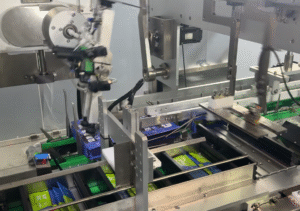
Vendors compete on footprint, and "compact layout" reads well in a proposal. It can also be the wrong target. Take the two published footprints above: 1,600 mm of labeling machine and 3,300 mm of cartoner. Place them end to end with a narrow gap and the drawing looks tidy. Then ask where an operator stands to change a label reel, how far the cartoner's guard door swings, which side the blank trolley arrives from, and where a rejected carton leaves the line. Four questions, and a tidy drawing tends to answer none of them.
Ask for the layout to mark four things explicitly: the maintenance aisle width on each side, the operator side used during changeover, the supply path for blanks and label reels, and the reject outlet. Check those against the actual column grid, door widths, and floor loading of the plant. A layout that trims two square metres by facing the changeover side into a wall pays that saving back on every SKU switch, a few minutes at a time.
A trial video usually shows product moving. Ask for the supply readings in the same run. When a line is asked to hold its rated rate, a current reading and an air-pressure trace at the manifold tell you more than a clean pallet does: they show whether the plant has margin left or is already at its ceiling. A line that holds rate with the pressure gauge sitting at the lower limit will not hold it on a humid afternoon with two more stations running.
Ask for one continuous recording at the agreed rate, with a format change in the middle and a rejected unit handled on camera. We have set out that approach separately in our frozen cup line project, where the acceptance test had to settle questions the brochure could not. On a whole line, add the supply readings to the same recording. It is the cheapest way to find out whether a rate is a machine capability or a plant capability.
A turnkey packaging line is not the right scope for every project. Adding a single station to a line you already run does not need a whole-line contract. One cartoner feeding your existing conveyors is a normal purchase. But the plant conditions still change, and they change against a fixed supply. Before that machine ships, someone has to check the spare capacity of the board, the remaining air flow, and whether the new footprint closes an aisle you use for something else.
Deciding whether to automate in stages is a separate question about timing and budget; we wrote about that in a piece on moving from folding to cartoning. The plant condition register is not a schedule. It is a running ledger: every station added, staged or otherwise, gets a row, and the totals get recalculated. Leave the ledger alone and a later-phase machine arrives with nowhere to run at its published rate.
Which plant conditions get missed most often in a line quotation?
Installed power total, peak compressed-air flow, and maintenance aisle width. Voltage and footprint appear on nearly every sheet; the totals appear on none.
If every station says 220 V / 50 Hz, is the electrical design done?
No. Voltage describes the supply type. Breaker and circuit sizing need installed power per station and the pattern of simultaneous starts. Ask for both.
Can we keep our existing distribution board and compressor?
Possibly, but decide from the merged table, not from five individual sheets. Measure the spare capacity before anything else, then confirm the line's peak draw against it in writing.
How does our existing filler connect to a new line?
Agree the infeed height, container pitch and handshaking signal during the format review, and add the filler's own supply conditions to the register. Upstream equipment belongs to the same plant, even when it belongs to a different contract.
What changes in the plant when we change format?
Label reels, blank sizes and case sizes change the supply path and the space around the station. Check that the trolley route and the reject outlet still work for the new format, not just for the one on the drawing.
What should the commissioning recording show?
One continuous run at the agreed rate, a format change, a rejected unit, and the current and air-pressure readings during that run. A clean pallet without the readings proves the product moved; it does not prove the plant can repeat it.
For a trial we need the product itself, the blank cartons, the case and pallet formats you use, and the rate you are planning for. Add a short sheet of plant conditions: available supply and spare breaker capacity, compressed-air pressure and flow, the usable floor length and width, the column grid, door widths, and floor loading. That last sheet is what lets the engineering team tell you whether a proposed rate fits your building, rather than just fitting a test bench.
Nothing about the trial obliges you to buy. What comes back is a recording of the whole run, changeover included. Bring the register to the kickoff meeting: how a supplier handles the empty cells tells you most of what you need to know — work through them alongside you, or steer the conversation back to machine counts before the totals are agreed.
If you want to review formats, plant conditions, or a line being built up from equipment you already have, our team is at helen@huanlianauto.com.

 Guangdong Huanlian intelligent Packaging Group Co., LTD
 86-15915757872
 86-13602308576
 sales@huanlianauto.com
 No. 7, Silver Lake Road, Sangyuan Industrial Zone, Dongcheng District, Dongguan City
 Back to top


 86-15915757872