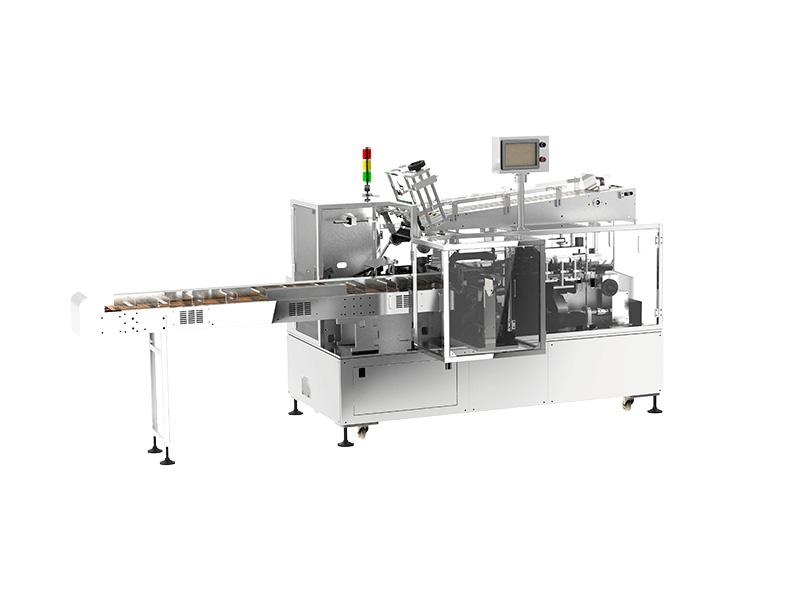
Cookie Cartoning Case Study: Hot-Melt Glue Sealing Cuts Staffing from 8 to 2
When food manufacturers shop for automated cartoning equipment, the shortlist of goals rarely varies: fewer hands on the line, higher throughput, or a packaging step that has blocked production for too long. The biscuit manufacturer in this case study wanted all three — plus one requirement that made manual work noticeably harder than a standard fold-and-tuck box: every carton had to be sealed with hot-melt adhesive.
That single condition turned an otherwise ordinary packing job into a slow, messy, and expensive operation. What makes this story worth reading, though, is how it began: the factory owner spotted a short video of a glue-seal cartoning machine on a social video platform, recognized the equipment his workshop had been missing, and moved from that initial phone call to a running production line — staffing down from eight operators to two — in roughly a month.
The factory is a mid-sized biscuit and snack manufacturer in central China. Each day its lines produce tens of thousands of individually wrapped biscuit packets, supplied both to supermarket shelves and to e-commerce warehouses. Every packet leaves the primary packaging line and enters a secondary packaging step: loading into a retail-ready carton that is closed with hot-melt adhesive.
The glue-sealed carton creates a tamper-evident closure — once the bond is broken, the carton cannot be reclosed without visible damage. Food brands favor this format for practical reasons: it reduces the chance of packages being opened and replaced during distribution, and it cuts disputes over delivered quantities and condition. A simple tuck-end box, which can be opened and closed without leaving a trace, offers none of these safeguards.
For this manufacturer the glue-seal requirement was not open to negotiation. Several supermarket chains in its customer base had written carton integrity into their supply agreements. But the requirement also made manual packing considerably harder than it would have been with tuck-end boxes: the same loading job now demanded gluing, pressing, and holding — every single carton, all day.
Before the change, the secondary packaging station ran with eight operators in a single task chain:
The problems clustered around the two gluing positions. Too little adhesive and flaps peeled open in transit; too much and the finished carton looked sloppy; not enough holding time and the bond was too weak to survive downstream handling. Every shift produced a pile of cartons needing rework — flap pried open, dried adhesive scraped off, fresh glue applied, carton re-sealed. Rework consumed productive hours and introduced a second round of quality risk.
This was not a training problem. It was a physical limitation of manual work: hands cannot repeat the same glue bead geometry, pressure, and setting time on every cycle. A machine can.
The factory's situation was far from unique. According to China's National Bureau of Statistics, the average annual wage of production and manufacturing personnel at industrial enterprises above designated size reached 80,739 yuan in 2025, and manufacturing wages grew 5.2 percent year on year. Industry analyses also put the labor share of food-industry costs at roughly 12 percent in 2024, up about 3 percentage points from 2019. Hiring is harder and more expensive each year, which is a growing reason food plants look at secondary packaging automation. The broader market numbers tell the same story: the size of China's food packaging machine market grew from 12.02 billion yuan in 2019 to 43.37 billion yuan in 2023, according to data compiled by the China Food Industry Association and the National Bureau of Statistics.
The factory owner had spent months looking for an automation solution for this station. The requirements were tight: the machine had to handle glue-sealed cartons without any change to the existing box dimensions; it had to open, load, and seal in one continuous cycle; and seal quality had to stay consistent at line speed.
One afternoon, scrolling through a short-video platform, he came across a clip of a glue-seal cartoner running exactly that sequence: a blank lifted from the magazine, a box formed, wrapped product pushed in, a clean adhesive bead laid on the end flaps, flaps pressed and held, sealed carton discharged. It was the manual process he knew — minus the inconsistent glue, the rework pile, and the eight-person payroll. He contacted the manufacturer the same day.

The biscuit maker had a confidentiality concern. Sending real product samples to an equipment supplier would hand over package formats, product dimensions, and production details to an outside party. The supplier proposed a different route: the customer provided the carton blank dimensions, the product dimensions, and the required count per box. The supplier sourced similar-sized blanks from its own stock, set the machine's infeed and sealing parameters to match the customer's specifications, and ran a trial cycle — recorded on video and sent to the customer.
The video showed the carton being opened and formed, simulated product advancing through the infeed, the adhesive bead being applied, and the carton being sealed at production speed. The customer could judge closing quality, adhesive pattern, and cycle time without disclosing a single proprietary detail. Three days after reviewing the video, he placed the order.
One month after the initial contact, the glue-seal cartoner was installed and commissioned. The secondary packaging station changed from an eight-operator manual line to a two-operator machine-assisted flow:
The tasks that previously occupied six people — unfolding blanks, loading product, applying glue, closing flaps — are now carried out by the cartoner in a continuous mechanical cycle: blank pickup, box forming, count-accurate loading, hot-melt application at programmed temperature and pattern, flap pressing, adhesive set time, and discharge, all without operator intervention.
Output was consistent from the outset. The manual line's output had drifted through the day — brisk in the morning, slower as fatigue set in, interrupted by rework whenever downstream inspection flagged glue problems. The cartoner delivered the same throughput at 9:00 a.m. as at 4:30 p.m. Carton defects caused by adhesive issues dropped sharply, and the rework station was removed because there was little left to rework.
A glue-seal cartoning machine performs the full secondary packaging sequence in one repeating cycle:
The hot-melt system is what separates a glue-seal cartoner from a tuck-end machine. Our machines are fitted with internationally branded hot-melt applicators that hold adhesive temperature and bead geometry steady across a full shift. Temperature, bead pattern, and set time are programmed through the touchscreen HMI and can be adjusted for different carton sizes and adhesive formulations without any mechanical changes.
Manual glue application looks simple until it has to be done correctly at production volumes. The operator applies hot-melt adhesive to the flap with a gun or brush, presses the flap down, and holds it for the required setting time. At the volumes retail and e-commerce channels demand — thousands of cartons per shift — manual gluing becomes the bottleneck and the quality risk at the same time.
The causes are built into the process. Glue temperature drifts as the pot cools between applications. Bead pattern shifts with hand speed and motion. Setting time varies with fatigue. The result is seal quality that changes across a shift and across operators. Downstream inspection catches the worst failures, but borderline cartons pass through and fail later, in distribution.
A cartoner removes these variables entirely. The same applicator lays the same bead at the same temperature and pressure on every cycle. The same mechanical closure presses each flap with the same force for the same duration. Seal quality is effectively indistinguishable from the opening carton of a shift to the closing one, no matter how long the machine has been running or who is tending the infeed.
The direct part of the calculation is straightforward: six positions removed from the station, eight operators down to two. The two remaining roles — infeed and discharge — require less training, less physical effort, and less specialized skill than the folding, gluing, and holding jobs they replaced.
Using the National Bureau of Statistics figure of 80,739 yuan as the average annual wage for production and manufacturing personnel in 2025, and adding social insurance, housing fund, meals, and recruiting and training overhead, a realistic total cost per packaging operator lands in the 80,000–100,000 yuan range. Six positions therefore represent roughly 500,000 yuan in annual savings — an amount on par with the purchase price of a cartoner, putting the payback period at around one year.
Three indirect savings added to the case:

The glue-sealed carton is a common choice for food sold through supermarkets and e-commerce, for reasons that have nothing to do with looks:
Tamper evidence. A glue-sealed carton cannot be opened and reclosed without visible damage — prying the bond apart tears the carton surface. For manufacturers shipping to retail and online buyers, that property reduces disputes about quantity and condition at delivery.
Structural integrity in transit. A properly sealed carton stays closed through the vibration, stacking pressure, and temperature swings of long-haul distribution. Tuck-end boxes can pop open under those conditions; glue-sealed boxes generally do not.
Retailer requirements. Major chains are increasingly specifying tamper-evident or glue-sealed formats in their food packaging standards, and compliance is a condition of supply.
Our glue-seal cartoners run at 1,500 to 2,400 cartons per hour with internationally branded hot-melt applicators, keeping pace with retail-bound food production.
The biscuit maker's results came from an operating pattern that applies across food categories:
Which hot-melt adhesives does the machine support?
Standard food-grade hot-melt adhesives used in secondary packaging. Temperature range and bead pattern are programmable on the HMI. If you use a specific adhesive formulation, send a sample with your carton blanks during the trial and we will verify compatibility.
Does the machine need compressed air?
Yes — the hot-melt applicator requires a compressed air supply. Our installation team checks your facility's air system during the pre-purchase technical review.
Can one machine switch between glue-seal and tuck-end cartons?
A machine is configured for one closing format at the time of manufacture. If you produce both formats, configure the machine for the format covering most of your volume.
What are the minimum and maximum carton sizes?
They vary by model. We confirm dimensional compatibility during the pre-purchase review using your carton sample, and the trial run verifies that your blanks feed, form, and seal correctly.
How long do installation and training take?
Installation and commissioning typically take one to two days, and operator training about two hours. Every machine includes a one-year warranty covering parts and service.
The pace of this project is worth setting out:
From the initial call to a running line, the whole project took less than five weeks. For the biscuit manufacturer, the labor savings and quality gains arrived in the same quarter as the automation decision — no long transition, no production disruption.
Food moving through retail and e-commerce supply chains faces handling tests at every stage: pallet stacking, truck transport across climates, automated sorting in distribution centers, and staff placing cartons on shelves. A carton properly sealed at the factory arrives sealed; one with a weak bond fails visibly — popped flap, spilled product, damaged display.
This manufacturer had received a quality complaint about carton sealing from a retail buyer three months before the project. After the cartoner went in, that complaint did not repeat. The supply-chain improvement was immediate and measurable.
On compliance: factories audited under SQF, BRC, or FSSC 22000 have specific expectations for equipment and materials in food production areas. The hot-melt adhesive must be food-grade and must not transfer to the product or the carton interior during sealing. Our glue-seal cartoners use internationally branded hot-melt applicators that hold adhesive temperature steady, and the adhesive is applied to the flap surface — outside the product containment zone of the sealed carton. The machine frame is stainless steel with food-contact-adjacent surfaces meeting sanitary design requirements, and the adhesive system includes drip trays and shields to prevent residue build-up. For facilities with allergen segregation or specific cleaning protocols, we provide a detailed equipment specification to check against the relevant food-safety standards.
The biscuit maker runs multiple SKUs with different carton dimensions and pack counts. On the manual line, each changeover meant re-setting the glue application, adjusting folding guides, and re-training operators on the new count — typically 30 to 45 minutes. On the cartoner, dimensional changes within the same box style take under ten minutes: the operator turns handwheels on the forming and closing modules while target dimensions show on the HMI, and the adhesive parameters — temperature, bead pattern, set time — are recalled automatically when the SKU is selected.
For a plant running ten or more SKUs on one line, this adds up. At three changeovers per week, cutting the duration from 45 minutes to 10 minutes saves over 100 hours of lost production a year. If some SKUs require tuck-end cartons, switching between closing formats needs a planned module change, so we recommend configuring the machine for the format that covers the majority of volume.
Three factors decide the fit:
1. Carton format. The machine is built for glue-sealed cartons. Tuck-end or snap-lock bottom formats call for different configurations.
2. Product infeed. Product must arrive at the cartoning station in sealed primary packaging — a wrapper, pouch, or tray. Loose or bulk product needs a different infeed setup.
3. Volume. The economics favor volumes above roughly 500 cartons per shift, where the labor savings offset the machine investment.
Our pre-purchase evaluation covers all three. The standard process is: product and carton specification review → a free sample trial with video documentation → a layout plan confirming the machine fits your floor space and integrates with upstream and downstream equipment. The evaluation is free and carries no purchase commitment.
This case study reflects a pattern becoming common in food packaging: a manufacturer whose cartons must be glue-sealed reaches a volume where manual gluing stops making economic sense. The manual step occupies several dedicated positions, produces a measurable rework rate, and creates quality variation that a tuck-end line would never expose. A glue-seal cartoner addresses all three at once — eight operators become two, and the adhesive-related problems that defined the old process leave the floor with them.
The one-month path from discovery to production rested on three conditions any food manufacturer can meet: the machine matches the existing box format, the product arrives in sealed primary packaging, and a sample trial provides evidence of compatibility before purchase. If your plant is still sealing cartons by hand with a glue gun, the route forward is the same: replace every manual step with one continuous mechanical cycle, and let the numbers speak for themselves.
Data sources: National Bureau of Statistics of China, 2025 wage statistics for urban employment units; China Food Industry Association and National Bureau of Statistics, food packaging machine market statistics (compiled by HeadLeopard Research).

 Guangdong Huanlian intelligent Packaging Group Co., LTD
 86-15915757872
 86-13602308576
 sales@huanlianauto.com
 No. 7, Silver Lake Road, Sangyuan Industrial Zone, Dongcheng District, Dongguan City
 Back to top


 86-15915757872