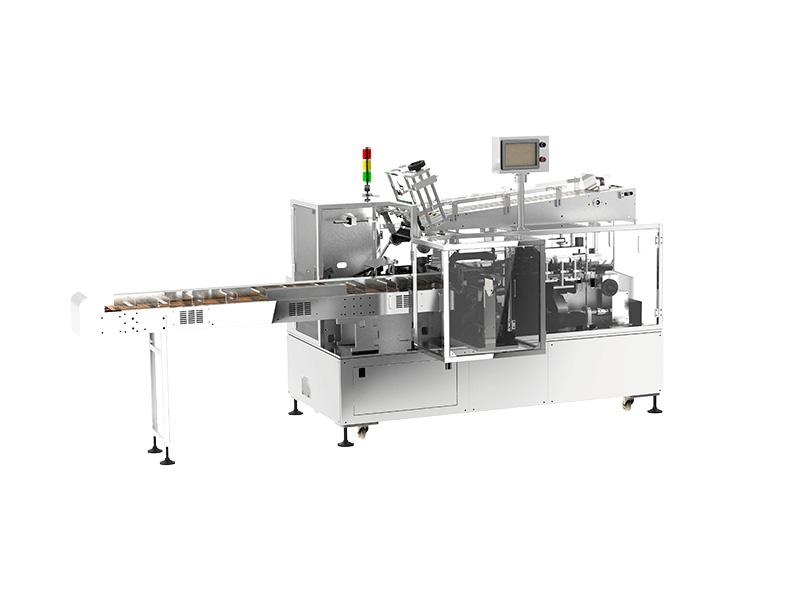
Automatic Cartoning Machine Case Study: How a Durian Line Cut 8 Workers to 2
Global durian trade is surging. China alone imported 1.87 million tons of fresh durian in 2025, valued at approximately USD 7.49 billion (General Administration of Customs, China). As the world's largest durian consumer — accounting for over 90% of global consumption — China's appetite is reshaping the entire Southeast Asian supply chain, from orchard to retail shelf.
For durian processors, this growth brings opportunity and pressure. Frozen durian flesh products require tamper-evident, cold-chain-ready packaging that maintains visual appeal through distribution. The packaging step — sliding sealed product trays into retail cartons — becomes a critical throughput bottleneck when done manually.
This case study examines how a durian processor replaced an 8-worker manual cartoning line with a single UBL automatic cartoning machine, reducing the workforce to 2 while increasing output consistency.
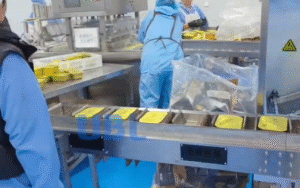
The processor packages individually sealed frozen durian trays into double tuck-end cartons — a box format where both ends close by tucking flaps into the box body. No glue, no tape, no adhesive. The product enters the cartoning station already sealed in its primary packaging (aluminum tray), meaning the cartoning operation is purely secondary packaging with zero direct food contact.
The manual cartoning station deployed 8 workers across four tasks:
| Task | Workers | Operation |
|---|---|---|
| Carton forming | 3 | Folding flat blanks into erected boxes |
| Product loading | 2 | Inserting sealed trays into formed boxes |
| End closing | 2 | Tucking both end flaps manually |
| Transfer | 1 | Moving completed boxes to downstream conveyor |
Three problems plagued this setup:
The processor selected a UBL high-speed automatic cartoning machine. The decision was driven by three converging factors:
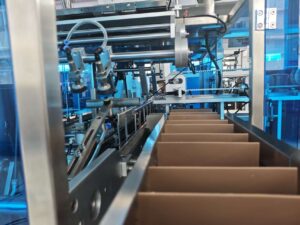
1. Native box-format compatibility. The double tuck-end carton is a standard format in UBL's machine portfolio — alongside snap-lock bottom boxes, glue-seal cartons, and mailer trays. No box redesign was required.
2. Secondary packaging eliminates food-safety barriers. Since the product was already sealed in primary packaging, the cartoning machine performed purely mechanical operations. No food-safety recertification or regulatory validation was needed.
3. Throughput match. Running at 70 boxes per minute, a single machine exceeded the 8-worker manual line's sustained output, eliminating the need for parallel machines or feed-splitting arrangements.
The evaluation process was straightforward: carton and product samples were sent to UBL for a live machine test. Compatibility was confirmed before any purchase commitment.
Post-installation, the cartoning station shifted from 8 manual workers to a 2-worker machine-assisted workflow:
Carton forming, product insertion, and tuck-end closing — previously the work of 6 workers — are now fully automated. The two remaining workers handle material flow, not packaging operations.
| Metric | Manual Line (8 workers) | Automated Line (2 workers + 1 machine) |
|---|---|---|
| Speed | Variable, fatigue-dependent | 70 boxes/min, consistent |
| Rework rate | 3–5% | Near zero |
| Quality consistency | Shift-to-shift variation | Uniform across all shifts |
| Downtime recovery | Depends on worker experience | HMI-guided, typically under 10 min |
The production manager reported that average daily output on the automated line exceeded the manual line's best-performing days, primarily because the machine eliminates the fatigue-driven slowdown that characterizes manual operations in the latter half of each shift.
Direct labor savings. Six workers removed from a single packaging station. Using China's National Bureau of Statistics figure of CNY 80,739 average annual wage for manufacturing workers (2025), direct annual savings reach approximately CNY 484,000. Including social insurance and benefits — which typically push total employment cost to CNY 80,000–120,000 per worker per year in coastal manufacturing regions — annual savings range from CNY 480,000 to 720,000.
Under single-shift operation, payback typically falls within 12–18 months. Dual-shift operations can compress this to 6–12 months.
Indirect savings. Beyond wages, the automated line eliminated rework from misaligned folding, reduced product damage during insertion, and removed costs associated with absenteeism, new-worker training, and cross-shift quality variation.
The deployment pattern is broadly applicable. Any food manufacturer whose product is already sealed in primary packaging — trays, pouches, sealed bags — before entering the cartoning station can adopt the same machine configuration without food-safety validation barriers.
UBL's cartoning machines natively handle double tuck-end boxes, snap-lock bottom boxes, glue-seal cartons, and mailer trays — formats that cover the majority of food retail packaging applications. In most cases, existing box designs require no modification.
Three factors to verify before automating:
Downstream capacity. When cartoning speed increases, labeling, case packing, and palletizing may become the new bottleneck. Right-size the machine to match sustainable line speed, not maximum machine speed.
Carton blank quality. The machine expects blanks within specification. If the carton supplier has inconsistent cutting or creasing, address that first — or verify compatibility during the sample test phase.
Operator training. UBL's standard program covers basic operation in 2 hours, with comfortable independent operation within 2–3 days. Each shift should have at least one trained operator. Common issues resolve in under 10 minutes via HMI diagnostics; UBL provides 4-hour remote response for complex problems.
The evaluation process is simple and risk-free. Send your carton and product samples to UBL — the technical team runs a live machine test with video documentation. You receive direct evidence of compatibility before making any purchasing decision.
For secondary packaging lines where labor cost, throughput consistency, and packaging quality are active concerns, this case demonstrates a clear pattern: one high-speed cartoner replaces the manual tasks of folding, loading, and closing — with payback measured in months, not years.

 Guangdong Huanlian intelligent Packaging Group Co., LTD
 86-15915757872
 86-13602308576
 sales@huanlianauto.com
 No. 7, Silver Lake Road, Sangyuan Industrial Zone, Dongcheng District, Dongguan City
 Back to top


 86-15915757872