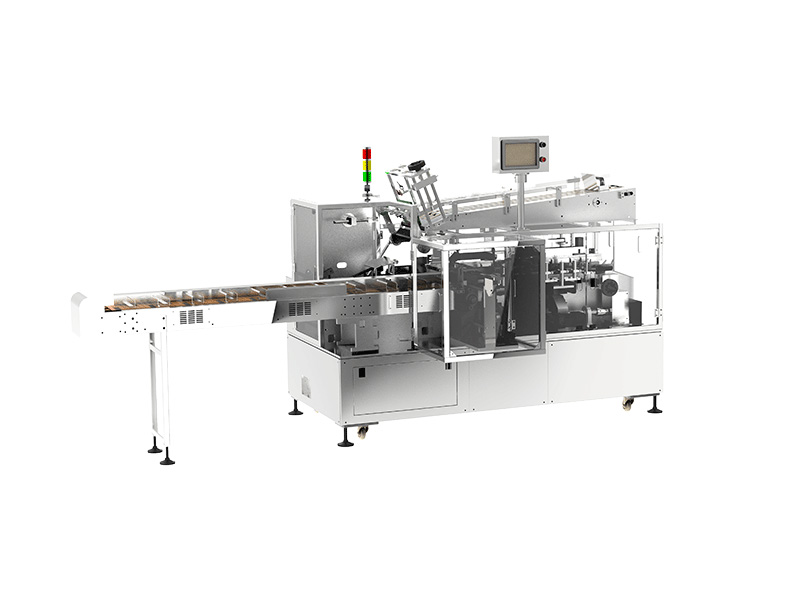
Ice Cream Cartoning Machine Case Study: A Frozen Cup Line Rebuilt for Retail Volume
An ice cream cartoning machine usually enters a plant's capital plan after a number goes wrong on someone's spreadsheet: an order volume the current line cannot pack, a labour budget that climbs every season, or a retailer audit note about carton appearance. This article walks through a project our engineering team at Huanlian UBL delivered for a frozen dessert manufacturer supplying a large North American retail chain — sealed cups of ice cream and frozen yogurt, grouped four to a retail carton. The plant and the retailer stay unnamed. What transfers to your line is not their order book; it is the sequence of engineering decisions, and those apply to any plant that pushes sealed frozen cups into secondary packaging.
The product was individually sealed cups, filled and lidded upstream, arriving at secondary packaging straight out of the hardening tunnel. The retail side of the relationship governed the box: the carton had to sit square on the shelf, show a clean and even seal line, and carry an exact count per case on the pallet. Retail packaging specifications of this kind are not suggestions — they are conditions of staying on the listing, and every packaging decision downstream inherits them.
The manual line had three stations: counting, loading, and closing. Counting formed the cups into sets of four, loading set each group into an opened carton, and closing sealed the flaps. At the volumes the plant started with, it worked. The ceiling arrived with the order growth. Output on a manual line scales with headcount, and headcount in a chilled room is the hardest kind to hold on to — the work is repetitive, the temperature is against you, and the Bureau of Labor Statistics counted 3.3 recordable injury and illness cases per 100 full-time workers in food manufacturing in its 2024 survey, against 2.7 for manufacturing as a whole, with repetitive reaching a known contributor. A plant that has to recruit twice a year for the same cold-room station is already paying for a cartoning machine; it is just not receiving one.
Anyone quoting a stock machine for frozen cups without asking about these four behaviours has not packed frozen desserts before.
Wet surfaces. Cups leave the hardening tunnel with condensation on the lid and walls. On a belt, that moisture changes the friction between cup and surface unevenly — a wet cup slides where a dry one grips. A grouping design tuned on dry demonstration cups is tuned on the wrong product.
Frost and temperature swing. Where room air meets a cup fresh from the tunnel, frost forms and then melts into droplets. Weight changes slightly, surfaces change a lot, and any sensor or gripper that assumes a dry, uniform product sees something different every cycle.
Light body, high centre of gravity. Until the lid is on, a retail cup is mostly air. Apply push force above the centre line and it tips — silently, so the fault surfaces as a jam two or three stations downstream instead of where it happened.
A rim that must not be touched. The lid seal is the food-safety boundary. Every handling step that presses on the rim is a risk to that seal, and a damaged seal is a quality claim from the retailer's receiving inspection, not a note in an internal log.
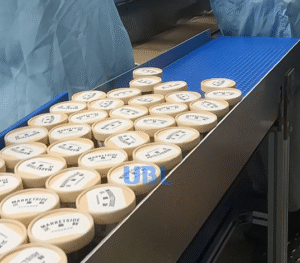
The automated line we deployed replaces the three manual stations with a measured sequence.
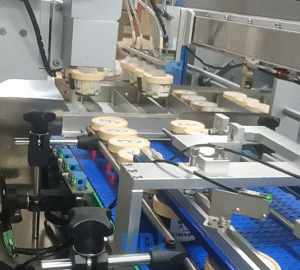
A vision system reads each cup's position and orientation as it arrives — cups from a hardening tunnel are never indexed the way a dry-goods infeed is, and pretending otherwise is where lost hours on similar projects usually start. A pick-and-place unit then lifts the cups into a two-by-two formation and sets it on the cartoner infeed; the pick coordinates live in the control recipe, so a four-count formation and a six-count family-pack formation differ by a recipe recall, not a rebuild.
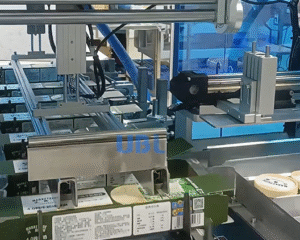
The cartoner draws a blank from the magazine, erects it, and holds it open at the loading position. A servo pusher advances the cup group in one motion, with an acceleration profile tuned to the cup's centre of gravity so nothing tips on entry, then closes the flaps. On our servo-driven tongue-insertion cartoning machine (model HL-ZC-G1), the published running range is 50–60 cartons per minute on boxes of L120–200 × W60–140 × H30–70 mm from a 220V/50Hz supply. One caution sits next to those figures: four-cup frozen dessert cartons often sit near the upper end of the width and height envelope, so a printed blank sample belongs in the specification conversation before anything is signed. Sealed cartons then exit to checkweighing, labelling, or case packing — the surrounding line, and how to stage it, is covered in our article on the full-line upgrade from folding to cartoning. Plants that prefer boxes pre-erected upstream can feed the loading station from a separate folder instead; the food carton folding machine guide covers that configuration.
The grouping stage is where frozen cup projects are won or quietly lost, and the correct choice depends on the arrival state of the product, not on the catalogue page.
| How the product arrives | What it is like | Grouping method that fits | Why |
|---|---|---|---|
| Indexed, single file, from an upstream unit | Rigid, evenly spaced | Mechanical grouper or direct infeed | Position is already known; vision adds cost without adding information |
| Loose from a hardening tunnel | Light, wet, unevenly spaced | Vision-guided pick-and-place | Every pick is measured rather than assumed, and wet friction cannot derail it |
| Multiple SKUs through one line | Format changes between runs | Recipe-driven pick coordinates | Changeover becomes a selection on the HMI rather than a hardware job |
On this project the cups arrived loose and wet, which put them in the second row of the table. The same question comes up across food categories — on snack lines the product arrives bagged rather than cupped, and our snack cartoning handbook works through that side of it. The honest way to settle the question for your own product is a trial with the cups as they actually arrive, wet surface included.
A cartoning machine for frozen desserts is specified differently from its room-temperature counterpart, in three places. The frame and product-contact surfaces are stainless, built for washdown adjacency and for the condensation a cold room produces daily. The electrical cabinet carries a rating suited to a wet, chilled environment rather than a dry hall. And the machine's behaviour has to hold at the temperature the hardening tunnel actually delivers — ask the supplier directly what changes at that temperature, and treat a vague answer as information.
The closing format is a separate decision, and on this line it followed the retailer's packaging spec: tuck-end closing, with the flap line running clean and square. Not every frozen project lands there. Where a tamper-evident seal or a heavier board calls for hot-melt glue, we build the glue-spray configuration as well — our glue-seal cartoning project at a cookie plant shows that route on a different product. The format decision belongs with the retailer's spec and the freezer environment, before the machine configuration is frozen.
Frozen dairy carries food-safety obligations a dry goods line never sees, and the clean place to draw the boundary is the lid. Once the cup leaves the filling line sealed, every operation downstream is secondary packaging — no food contact, no food-contact validation. A line that groups and cartons without a hand on the cups removes the manual touch points from the entire post-seal sequence, which shortens the food-safety conversation with any auditor to a walkthrough rather than a document exercise.
The money part of a case study rarely transfers between plants, so this section uses public figures instead. The Bureau of Labor Statistics OEWS program puts median pay for packaging and filling machine operators in food manufacturing at $21.32 an hour ($44,350 a year, 2025 estimates), and the average across all food manufacturing production employees stood at $24.76 an hour in October 2026 on the Current Employment Statistics series. Apply a 1.3 loading factor — a planning allowance for employer taxes, insurance, and benefits that each plant should replace with its own rate — and one staffed packaging position costs:
| Wage basis (BLS) | Hourly | Annual | Loaded annual (×1.3) | Per month |
|---|---|---|---|---|
| Median, packaging and filling machine operators, food manufacturing (OEWS 2025) | $21.32 | $44,350 | about $57,700 | about $4,800 |
| Average, all production employees, food manufacturing (CES, Oct 2026) | $24.76 | about $51,500 | about $67,000 | about $5,580 |
Multiply by your own station count, then apply a capture rate: when a line automates, people move to monitoring, inspection, and changeover roles rather than off the payroll, so a planning range of 60–70 percent of the table value is the realistic frame for most frozen-food plants. Payback is the equipment and integration investment divided by that captured figure — a supplier who quotes a payback period without showing you this division is quoting a hope, not a calculation.
Two savings sit outside the table and pull the same direction: rework from miscounted cartons leaves with the manual stations, and repetitive reaching in a chilled room leaves the job descriptions. Neither appears in the payroll line; both appear in the cost of quality.
No frozen cup project should reach a contract on datasheets alone. The acceptance test runs on the plant's own materials: filled, lidded, chilled cups — not warm empties, which behave differently — printed blanks exactly as die-cut for the retail format, and the target formations. The trial report should state four numbers: the sustained rate on those cups, the reject rate, the changeover time between two formations, and the behaviour after the line settles into steady running rather than the opening minutes. Video of the whole sequence lets your team review the grouping, the pusher entry, and the closing line before any commercial step.
Can one line run four-count cartons and six-count family packs?
Yes, when both formats sit inside the cartoner's box envelope (L120–200 × W60–140 × H30–70 mm on the HL-ZC-G1). The pick coordinates and pusher settings are stored per SKU as recipes, so the change is a selection on the control panel plus the mechanical adjustments that go with a different blank. A format outside the envelope needs a different machine configuration — confirm with blank samples.
How does the line cope with condensation on the cups?
The belt, gripper, and guide materials are chosen for wet surfaces, and the vision layer measures position rather than assuming it, so a wet cup that slides on the belt is still picked correctly. The trial should be run with chilled, wet cups for exactly this reason.
What happens if a cup is missing from a group?
The count is verified before the group releases. A short group skips its cycle and the event is logged, so the cartoner never consumes a blank on an incomplete set and no short-count carton is closed.
Does the machine sit inside the cold room?
Two workable layouts exist: a machine rated for continuous operation inside the chilled area, or a machine at the room boundary with a short enclosed transfer from the tunnel. The choice follows the plant layout and the temperature the product is at when it arrives. Either way, ask for the cabinet rating and the operating temperature range in writing.
What should we send for a trial?
Cups as they are produced — filled, lidded, chilled — plus printed carton blanks and the formation you need. We run the group-and-carton sequence on video and return the four numbers from the acceptance test above.
The specification that decides this project is your product's, not ours. Send the cup samples and the printed blanks, tell us the formation and the target rate, and our team will run the sequence on camera — grouping, loading, closing, changeover, reject count — for your review before anything commercial happens. To talk about a frozen cup cartoning line, write to helen@huanlianauto.com.

 Guangdong Huanlian intelligent Packaging Group Co., LTD
 86-15915757872
 86-13602308576
 sales@huanlianauto.com
 No. 7, Silver Lake Road, Sangyuan Industrial Zone, Dongcheng District, Dongguan City
 Back to top


 86-15915757872