

Carton Folding Machine Selection: A Decision Path by Box Type and Volume
Carton folding machine selection is not a machine question. It is a carton question that ends in a machine. A procurement manager in Dongguan sent us a photo last month with one line of text: "We fold these by hand, eight people, two shifts. Send me a price." The photo showed a corrugated mailer box with a crash-lock base. He wanted a quotation, but what he needed first was a decision path, because the machine that folds that box well is not the machine that folds a tuck-end retail carton, and the speed he would have been quoted would be wrong for the volume he actually runs.
Many carton folding machine selections fail before the quotation arrives, and they fail for the same reason: the buyer starts from a catalogue and works backwards to the box. The workable order is the reverse. Fix the box, fix the weight, fix the volume, decide how deep the line should go, then look at machines. How to choose a carton folding machine is therefore a sequence of five decisions rather than a single comparison. This guide walks through that sequence, with the trade-offs at each step and the questions worth putting to a supplier before you sign anything.
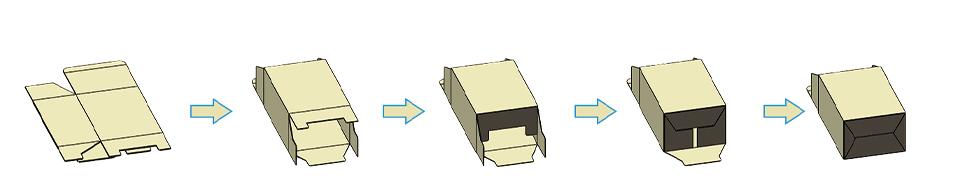
From flat dieline to erected carton: the fold sequence that decides which machine category applies
A carton erector is a geometry-specific machine. The folding sequence for a snap-lock base — panels creased, side panels raised, interlocking tabs pressed home — shares little mechanism with a tuck-end carton, where side flaps tuck into slots, or a rigid two-piece box, where a lid and a base are formed from separate blanks. The machine is built around the base structure, which is why a catalogue cannot answer the question for you.
There is a practical test you can run in ten minutes before contacting anyone. Take one blank of the carton you actually use, lay it flat on the table and look at the base:
Read that list against your own blank. The carton folding machine range covers all four categories, with size range listed per model. Buyers who get it wrong are not careless; they are working from a packaging description written by someone else and inherited without ever looking at the board.
| Box structure | How the base closes | Machine category | Where it is used |
|---|---|---|---|
| Snap-lock bottom (auto-lock, 1-2-3 bottom) | Interlocking flaps, no adhesive in the assembly | Snap lock bottom carton erector | Electronics accessories, cosmetics, hardware multipacks, food trays, e-commerce items above roughly half a kilo |
| Tuck end (straight or reverse tuck) | Tab friction-fits into a slot in the side panel | Tuck end box erector | Light cosmetics, pharmaceuticals, FMCG and retail display cartons, typically under 400 to 500 grams |
| Corrugated mailer box | One-piece board, glued or crash-lock base, fold-in side panels | Corrugated mailer box folding machine | E-commerce shipping, subscription boxes, direct-to-consumer fulfilment, gift sets |
| Two-piece rigid box | Two separate blanks, lid and base | Rigid box forming machine | Premium cosmetics, fragrance gift sets, fruit gift boxes, jewellery, high-end electronics accessories |
Two deserve a note. A tuck end box erector for light retail cartons and a snap lock bottom carton erector for heavier lines are different machines, and neither converts into the other without a module change. A tuck-end carton costs less per blank than a snap-lock carton of the same size, because there is no interlocking geometry to die-cut. And a rigid box is quoted per pair, since the lid and the base arrive as two separate blanks and each needs its own forming station.
Box structure is not decoration. It is the load path.
Under 300 grams, a tuck-end carton is structurally sufficient and cheaper per blank. Between 300 and 500 grams you are in the border zone. Tuck-end still works, provided handling on the way to the customer is gentle and the base tabs are not being strained. A snap-lock bottom buys margin here, and margin is worth something when parcels travel through a network that stacks them, throws them, and stacks them again.
From 500 grams to 2 kilograms, a snap-lock base is the sensible default. The load spreads across four panels instead of concentrating on two tab edges. Beyond 2 kilograms, go to a snap-lock base or a reinforced rigid box, and for shipping work look at double-wall corrugated mailers with crash-lock bases.
The failure mode is worth understanding, because it does not appear in the factory. A tuck-end carton holding too much weight does not fail on the packing table; it holds together, travels through the courier network stacked under heavier parcels, and opens along the tab line. Your customer receives a damaged product and a box that looks opened. Tuck-end cartons hold light items reliably and hold heavy ones until someone stacks them for two days. That failure arrives as a returns pile, which is a considerably more expensive problem than the blank saving.
A rigid box forming machine for a gift set is not a rigid box folding machine for a cosmetics tray, because the board, the blank size and the fold sequence differ, and the carton folding machine acceptance test for one says nothing about the other. The corrugated mailer box folding machine is the one category where board grade and parcel count decide the answer before any other question does, because the material is the constraint, and a carton folding machine quoted without a board grade is a quotation you cannot compare. Two practical consequences follow. If your product weighs 80 grams, the extra cost of a snap-lock blank is waste. And if your SKU list crosses weight bands, you are looking at two box structures and therefore two machine categories — plan for that from the start rather than discovering it when the 1.8-kilogram line jams on a tuck-end carton that was not designed to hold it.
The second decision is how many boxes per day, and the useful part is the arithmetic rather than a speed number.
Required rate (boxes/min) = daily output ÷ shifts ÷ net productive hours per shift ÷ 60
Net hours are not shift hours. Deduct changeovers, breaks, sanitation and short stops. Six to seven hours of productive running in an eight-hour shift is a realistic planning assumption, and using eight will leave you with a machine that looks adequate on paper and sits idle at the bottleneck.
Work one example. A plant running 20,000 cartons a day on two shifts at six productive hours each needs 20,000 ÷ 2 ÷ 6 ÷ 60 = 27.8 boxes per minute, sustained. A carton erector rated at 40 boxes per minute covers that with room for changeovers and stops. The same plant at 20,000 cartons a day on a single eight-hour shift with seven productive hours needs 47.6 boxes per minute, a figure that changes the carton folding machine class outright, and the arithmetic tells you that before you read a single brochure.
Two rules of thumb keep this honest. Size for the peak day, not the average day; a plant shipping seasonal goods has a peak three times its average, and the peak is when the customer complains. And if the business has been growing 20 to 30 percent a year, size for where it will be in 18 to 24 months, not where it is today. A machine that is too small becomes a bottleneck as surely as a manual folding table does, and it becomes one after the purchase order has already been signed.
The demand behind those numbers is not hypothetical, and the corrugated mailer box folding machine has become the machine category a carton erector buyer quotes often. China's State Post Bureau reported 198.95 billion express parcels in 2025, up 13.6 percent year on year, with express service revenue of 1.5 trillion yuan. Every one of those parcels is a corrugated mailer box, and the plants serving that volume are precisely the ones where a corrugated mailer box folding machine stops being an option and starts being arithmetic.
On the equipment side, the market has been moving quickly. China's National Bureau of Statistics reported that packaging machinery output rose 32.3 percent year on year in July 2025, driven by equipment renewal policy, so the price-to-performance spread between machine classes has been working in buyers' favour for a while.
"Fully automatic" is a slogan, not a specification. The honest question is how much of the packing operation you are willing to automate at this stage, and in what order.
Level one: the folder alone. The carton erector erects boxes and delivers them to a conveyor; loading, sealing and labelling stay manual. This removes the folding crew from the roster and leaves everything else as it was, and it is the cheapest way to put a carton folding machine to work in a plant that has not run one, which is why it is where carton folding machine projects usually start. It suits plants under 10,000 cartons a day, plants with limited floor space, and companies that want to see how a carton folding machine behaves on their own product before committing to a full line. Our snap lock bottom carton erector HL-ZHK10C, specified at 600 to 700 pieces per hour with a 10 to 15 minute size change, sits at the lower end of that band and covers a one-shift operation comfortably. On typical Chinese manufacturing wages, payback on this level commonly lands in the 4-to-12-month range, though the figure moves with local labour cost and actual volume.
Level two: folder plus downstream stations. Add a loading station, automated labelling, check weighing, shrink wrapping. After the carton is formed, the rest of the line runs with minimal intervention. Throughput consistency improves noticeably, because a formed carton arriving at a predictable rate removes a variable that manual handling introduces. This level makes sense once volume is stable and the first level has proven itself, because a cartoner feeding from an unreliable carton erector inherits the same instability, and a carton folding machine that runs well but errs occasionally fills the line with misformed boxes rather than none.
Level three: integrated line. Erector to cartoner, labeler, check weigher, shrink wrapper, case packer, palletizer. Two operators can monitor a line that used to need ten to fifteen people. High-volume plants, multi-shift operations and new facilities are where this pays off.
There is no prize for reaching level three on day one, and a carton folding machine sized for level three on day one is money sitting on the floor. Level one typically delivers 60 to 70 percent of the labour saving at a fraction of the total capital outlay. Our customers arrive at the destination by different routes — some have installed a single folder and stayed there for years, others commissioned a full line — and both are reasonable outcomes.
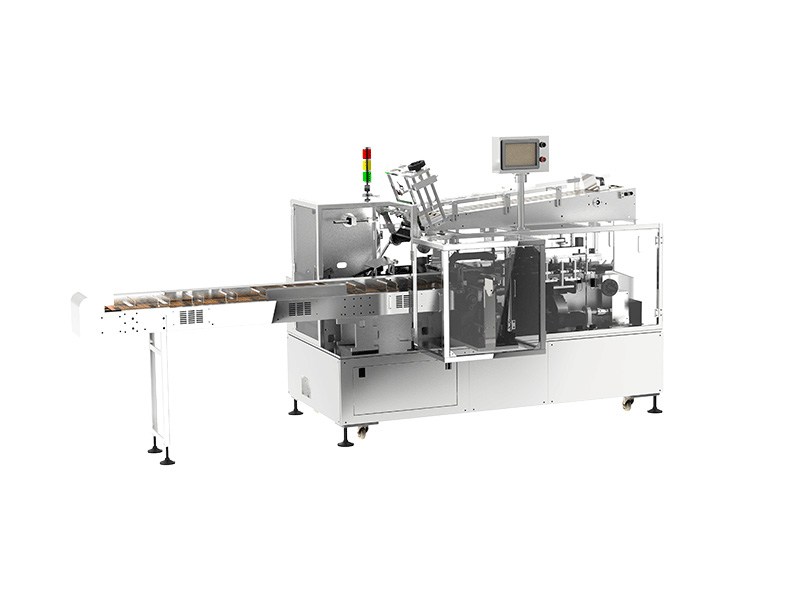
A folder positioned at the head of an existing packing line: the starting point for a plant of this size
Box type, volume and line depth narrow the field. These specifications close it. Each row below is something to get in writing, with a number attached, rather than a description to be impressed by.
| Specification | Why it decides the purchase | What to ask for |
|---|---|---|
| Carton size range (L × W × H) | It decides whether you need one machine or two. A plant running five sizes through a carton folding machine that covers four still has a manual station for the odd one | The adjustment range per model, confirmed against your own SKU list including the smallest and largest |
| Board type and thickness | Wrong specification produces jams, misfeeds and damaged blanks, and a carton erector outside its board range will do all three. Corrugated board E flute, B flute and dense paperboard each need different settings and different grippers, and a machine specified only for E flute will struggle the moment a B flute blank arrives on the magazine | Which flute types and thickness ranges the machine holds, and what happens outside those numbers |
| Changeover time | If you change sizes several times a day, every minute of carton folding machine changeover time is lost output. This figure is often quoted optimistically | Time for a dimension change within one box type, and time for a change of box type, quoted separately |
| Throughput | It has to clear peak demand with margin, measured in net productive hours | Rated speed for your box format, not the headline figure for the simplest carton |
| Folding accuracy | Misaligned creases propagate downstream into loading, closing and palletizing | Positioning tolerance on the forming stations, in millimetres |
| Control interface | It sets the training curve and the error rate during the first months | Screen type, recipe storage for repeat sizes, language options, diagnostic fault listing |
| Footprint | A machine that does not fit is a machine that cannot be installed, so check the footprint before ordering rather than after the floor is marked out | Dimensions including magazine loading space and outfeed accumulation, plus the aisle needed to service it |
| Acceptance test | It is the only line item that settles disagreements later | A written carton folding machine acceptance test protocol using your blanks, with stated rejection thresholds for cycle time, fold position and damage rate |
Two of these deserve particular attention, and the carton folding machine changeover time is the one quoted more loosely than any other figure on a quotation sheet, so ask for it separately and ask what it covers — a dimension adjustment within one box type is a different operation from swapping a forming module, and the gap between those two numbers is often larger than the quote suggests. Ask for the carton folding machine changeover time as two line items, one within a format and one across formats, and hold the supplier to the figures in writing: a machine that changes size in ten minutes and one that changes format in an hour are different machines wearing the same specification. And the carton folding machine acceptance test is worth writing into the contract as a document with numbers in it, because it is the only mechanism that protects both sides when the machine arrives and the output is not what the demonstration suggested, and it costs nothing to write properly before the order goes out.
Once the specification is settled, the numbers on the quotations finally become comparable — and only then. Carton folding machine price varies by an order of magnitude across the range, and a comparison made before the specification is fixed compares different things.
How to choose a carton folding machine on price alone is a mistake. Four items belong on every quotation, in the same layout, so that they can be set side by side:
A carton folding machine price that looks low often reflects a narrower scope. That is not a reason to distrust the supplier — different scopes genuinely cost different amounts — but it is a reason to compare the scope lines rather than the totals on page one. When two quotations are genuinely close on carton folding machine price, the tie usually breaks on the acceptance test: the supplier willing to put their own blank through their own machine, in writing, with a rejection threshold, is the one telling you how they intend to handle a dispute in year two.
Our approach is straightforward. Send the carton drawing and the hourly target, and we will tell you which machine runs it and what it costs. If the numbers do not work, we will say so — a machine that sits idle because it was oversized is worse for your plant than no machine at all.
This is the step that converts a likely machine into a known machine, and it is the step that gets skipped under schedule pressure.
Send the supplier 50 to 100 flat blanks of your actual carton — the real material, the real die-cut, the real print — because a carton folding machine sample trial on the supplier stock proves very little. The supplier runs them on the matching model and records the full cycle, from blank pickup through to the formed carton coming off the outfeed. You receive the video and a short written report: the throughput observed, any adjustment the machine needed, and confirmation that the material ran cleanly. Ask for the report in writing alongside the video, since the report is the document that becomes your acceptance record.
A corrugated mailer box folding machine running E flute at a rate it was designed for B flute will crease across the flute tips and split at the score line, so board grade belongs in the specification, not in a footnote. The value of that carton folding machine sample trial video is not the sales pitch around it. It removes the uncertainty a demonstration on the supplier's own stock cannot remove — whether your board, with your creases and print registration, runs without jamming. Suppliers who have worked across several hundred carton formats have usually seen a version of your problem before, and the carton folding machine sample trial is where that experience reaches you. It costs nothing and carries no purchase obligation. Verifying the supplier before that trial is a separate exercise, and our supplier due diligence checklist covers the documents worth requesting first.

Enclosed forming cabinet with touch screen control and status tower — the standard configuration on current carton erector models
Sizing to average output. The plant runs 8,000 cartons a day on an ordinary day and 22,000 during the promotion fortnight. The machine was specified for 8,000. For eleven days a year the line cannot ship what marketing has promised. Size for the peak and take the margin cost into the business case from the start.
Buying one machine for four box formats. A single carton erector covering four formats means four forming module changes, four sets of carton folding machine changeover time and four sets of settings to keep current. If the format mix is genuinely that wide, two machines each covering two formats is often the cheaper arrangement over a year.
Ignoring the board. The carton folding machine handles the carton fine on the sample board and jams on production board. Fibre content, flute direction, caliper tolerance and crease depth all change between a sample run and a production lot. Specify corrugated board E flute and B flute grades by name rather than by carton dimensions alone, because the carton erector is configured against the board, not the drawing.
Forgetting the offload. The carton erector produces boxes faster than people can load them, so the constraint moves downstream to the packing table. A machine that doubles your output while the loading station stays the same has moved the bottleneck, not removed it.
Writing the acceptance test loosely. Vague acceptance wording gives both sides room to interpret a failed carton folding machine acceptance test generously in their own favour. Put the numbers in the document.
| Your situation | Where to start | Machine family to look at |
|---|---|---|
| Snap-lock bottom cartons for electronics or household goods, under 10,000 per day | Fix the box structure first, then size the speed | Snap lock bottom carton erector |
| Tuck-end cartons for cosmetics or pharmaceuticals, light products | Confirm the weight band, then decide folder alone or folder plus loader | Tuck end box erector |
| Corrugated mailer boxes for e-commerce shipments | Establish board grade and daily parcel count | Corrugated mailer box folding machine |
| Premium rigid boxes for cosmetics, gifts or fruit | Confirm the lid and base are separate blanks, then check the blank size range | Rigid box forming machine |
| Several box types across the range | Price one primary format, plan a second unit later | Ask for a quotation that states which format each price covers |
| A complete line from blank to sealed pack | Send the layout and the hourly target before asking for prices | Full line consultation with a proposed arrangement |
If you have read this far, the next step is a short list rather than a purchase order:

 Guangdong Huanlian intelligent Packaging Group Co., LTD
 86-15915757872
 86-13602308576
 sales@huanlianauto.com
 No. 7, Silver Lake Road, Sangyuan Industrial Zone, Dongcheng District, Dongguan City
 Back to top


 86-15915757872


