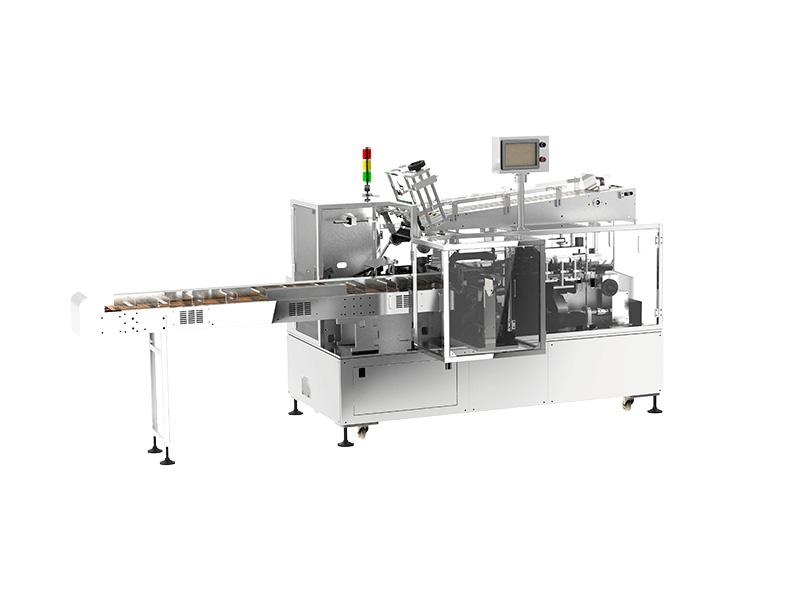
Custom Clothes Folding Machine: When Standard Configurations Don't Fit Your Production Line
Most garment folding machine buyers land on a catalog configuration: a fully automatic T-shirt line, a thick-and-thin model that handles heavier garments, or a semi-automatic station for lower volumes. But a meaningful share of operations don't fit neatly into any standard option — and forcing a non-standard requirement onto a standard machine usually ends one of two ways: the machine doesn't do the job correctly, or it runs only with daily manual intervention to compensate for what it cannot handle on its own.
A custom clothes folding machine is not a premium upsell. It is the practical engineering answer when your production reality diverges from what a standard unit was designed around. This guide walks through the five situations where a custom configuration makes sense, what an upgraded semi-automatic solution looks like in practice, and how the custom and OEM process runs from initial conversation to installation.
Every folding machine works within a defined envelope — a minimum and maximum garment length and width, and a corresponding folded output size. Oversized outerwear, very small children's garments, or unusual formats such as hospital gowns with tie closures can sit outside that envelope. A standard machine either cannot process them at all, or produces inconsistent fold quality at the edges of its range.
A custom configuration recalibrates the fold geometry, conveyor width, and fold-arm travel to your specific garment dimensions. If you produce across a wide size spread — for example knitwear and outerwear in the same facility — the multi-functional garment folding machine series is often the closest starting point before custom calibration.
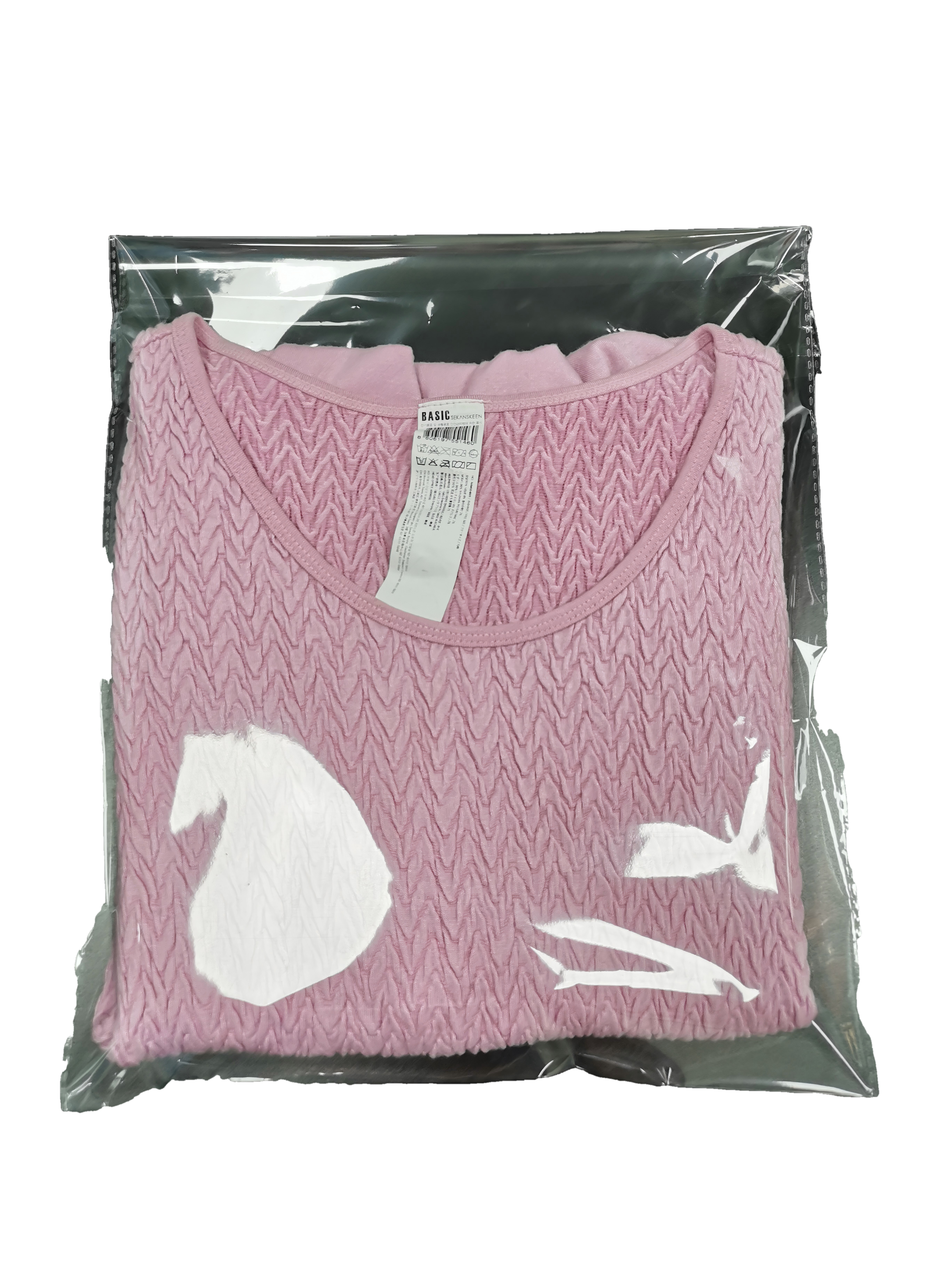
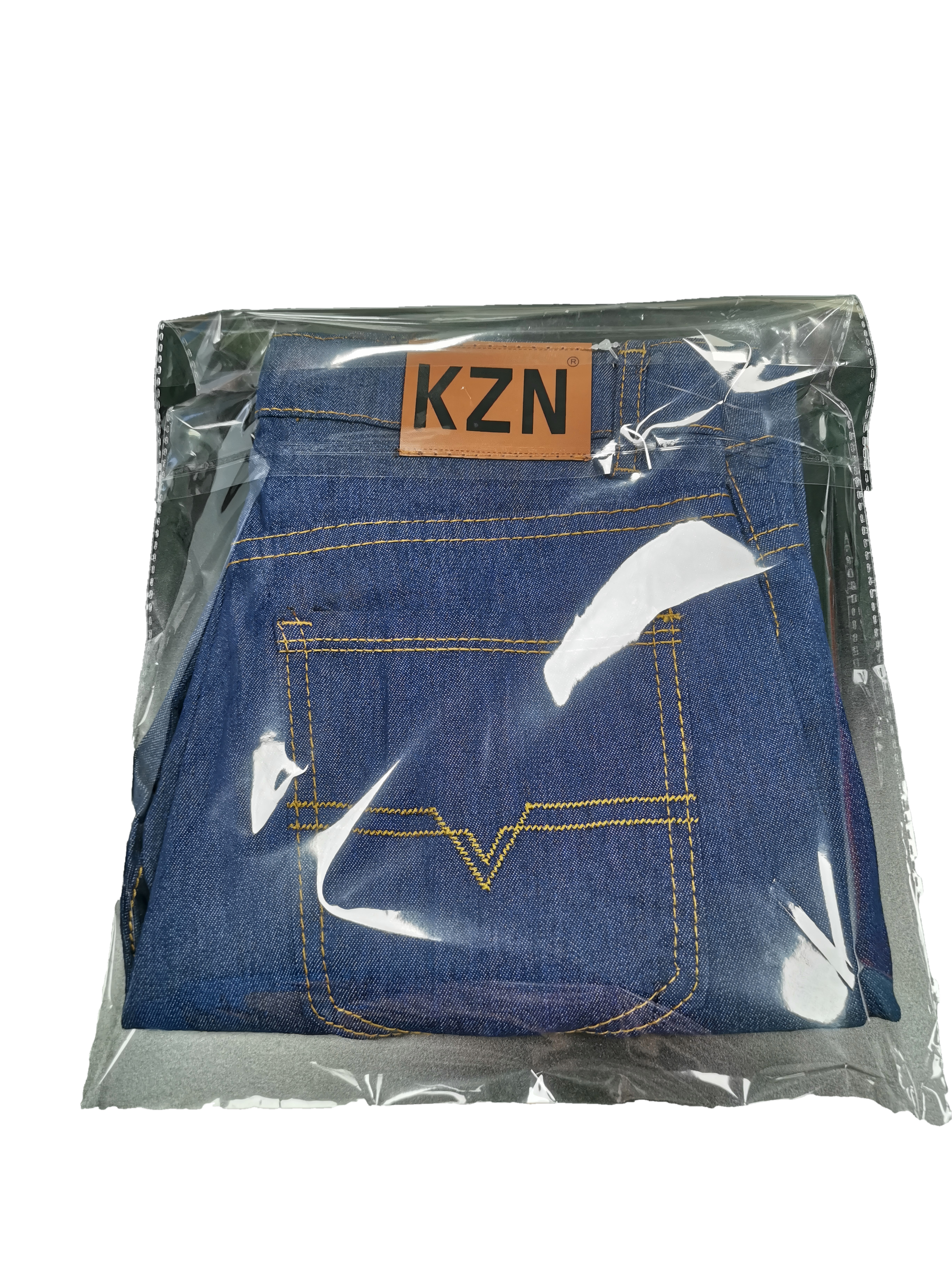
Some retail buyers and brands specify the fold in detail: the number of folds, the fold direction, the finished dimension, sometimes even label orientation on the finished pack. If your buyer's specification differs from the standard bilateral-then-longitudinal sequence, or the finished dimension sits outside standard output ranges, the machine must be configured to that specification before production starts.
Our HMI stores up to 99 parameter sets, so once the hardware is calibrated to the extremes of your required range, different buyers' fold configurations can be saved and recalled without mechanical reconfiguration.
A standalone folding machine with manual infeed and manual output collection suits many operations. But if your floor runs a continuous line — sewing or finishing through folding, bagging, labeling, and into carton packing — the folding machine has to connect mechanically and electronically with the equipment upstream and downstream.
Standard machines are not built for line integration by default. Custom configurations include the interface components, conveyor heights, and electrical connections that make the folding station a seamless part of the line. For lines that also need bagging upstream or downstream of the fold, our bagging machine series covers pre-made-bag and bag-making formats that can be matched to the folding station during layout design.
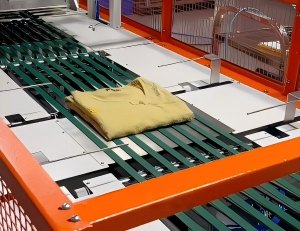
If your packaging format doesn't match standard polybag dimensions, seal types, or label positions, the bagging and labeling stations need configuring to match. Common examples include:
These are packaging-station changes rather than fold-mechanism changes, and they are usually scoped together with the folding configuration so the whole station ships as one integrated unit.
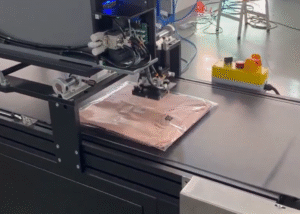
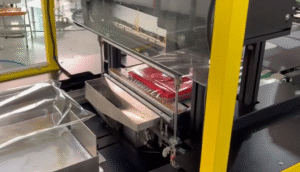
Some buyers need more capability than a standard semi-automatic unit but cannot yet justify a full-automatic line. For this group, the practical path is an upgraded semi-auto configuration: a semi-automatic fold base with automated bagging and heat-seal closure integrated downstream.
This delivers fold + bag + seal in one continuous sequence at approximately 400 pieces per hour, with a single operator at the infeed, at an investment level between standard semi-auto and full-auto. It is the right bridge when volume is growing toward full-auto justification but has not arrived there yet. For comparison, the standard configurations — including the single-station garment folding machine and the fully automatic garment folding and packaging machine — are described on their product pages.
A recent project illustrates how this works in practice. The customer needed a garment folding and packaging solution under two constraints: a limited budget and limited floor space, either of which ruled out a standard full-auto line.
A standard semi-auto unit would have covered the folding function — but folding was not the customer's bottleneck. Bagging and sealing, done manually, was. So we configured a customized semi-auto upgrade: the semi-auto fold base with automated bagging and heat-seal closure integrated downstream.
The result:
Output rose above the two-person manual process while the headcount at the station dropped from two to one.
Step 1 — Requirement assessment. We start with your production requirement: garment types and dimensions, fold specification, desired output format, daily volume, floor layout constraints, and downstream integration needs. From this we prepare an assessment that identifies whether the requirement is met by a standard configuration, a parameter adjustment to a standard model, or a genuine custom build.
Step 2 — Two layout proposals. For custom builds, we prepare two layout options — Option A and Option B — addressing the requirement from different angles. They may differ in footprint, throughput, investment level, or functional scope. You select the option that fits your priorities, or we refine a hybrid of the two.
Step 3 — Sample trial. Before the specification is locked, we run your garment samples through the closest existing machine configuration to validate that the core fold and bag mechanics work as expected. This surfaces garment-specific adjustments before production engineering begins — and it is the step we recommend every buyer complete. You can contact UBL to arrange a sample trial with your own garments.
Step 4 — Production and delivery. Custom configurations typically take approximately three months from confirmed order to delivery, covering engineering finalization, component sourcing, machine production, testing, and shipping. Standard machines ship the day after contract signing; the three-month timeline applies specifically to custom builds.
Step 5 — Installation, calibration, and training. Installation and calibration are included in the purchase price. For line-integration configurations, our installation team coordinates the mechanical and electrical connections to your existing equipment. Operator training covers all custom functions in addition to standard operation: roughly 30 minutes to basic proficiency, and 2–3 days to fully independent operation.
Equipment suppliers, system integrators, and large manufacturers who deploy machines across multiple facilities can take our garment folding systems under their own brand. OEM arrangements cover branding and documentation, and in some cases modified external housings or control panel interfaces. Minimum order quantities and terms are confirmed case by case — contact us directly to discuss.
Buyers who arrive with the following five items move through the assessment step noticeably faster, and the layout proposals come back more accurate:
If a specification is still open, that is fine too — the sample trial in Step 3 is designed to settle open questions with real garments rather than assumptions.
How do I know whether I need a custom machine or a standard one? Start with the standard configurations and check your garment dimensions against the stated compatible ranges. If your garments fall within range and your fold requirement is standard, a catalog machine with HMI parameter adjustment is usually sufficient. If your dimensions fall outside range, your fold specification is non-standard, or you need line integration, a custom configuration discussion is the right next step.
Does customization significantly increase the price? Minor customizations — parameter adjustments, non-standard bag dimensions within feasible ranges, label position changes — typically do not raise the price materially above standard. Significant customizations — extended frames, non-standard fold mechanisms, full line-integration engineering — add to the base cost in proportion to the engineering and component requirements. Every custom specification receives a detailed quotation before commitment.
Can I upgrade a standard machine with custom modules later? Some add-on modules — labeling stations, stacking units, vacuum compression — can be integrated with existing machines after purchase. Compatibility depends on the specific base model and the add-on. Discuss your planned upgrade path at the time of initial purchase so the base machine is specified with future integration in mind.
What is the lead time difference between standard and custom machines? Standard machines ship the day after contract signing. Custom configurations typically take approximately three months from confirmed order to delivery, including engineering, sourcing, production, and testing.
Can the machine handle both thick and thin garments in one configuration? The multi-functional and fully automatic configurations are designed for mixed thickness — T-shirts through jackets and sweaters. Extremes beyond the standard envelope, such as heavy blankets or very thin disposable garments, may need calibration; the sample trial confirms this before ordering.
What information do you need to prepare a quotation? The five items listed in "What to Prepare Before the Conversation" above — garment dimensions, fold specification, shift output target, floor space, and packaging format. With these, the assessment and the two layout proposals can be prepared in one cycle.
If your production requirement does not fit a standard catalog machine, start with a conversation. Describe your garment, your fold specification, your volume, and your layout constraints — we will assess whether a standard, upgraded, or fully custom configuration is the right answer and provide an A/B layout proposal.
Email: helen@huanlianauto.com Website: ublpack.com

 Guangdong Huanlian intelligent Packaging Group Co., LTD
 86-15915757872
 86-13602308576
 sales@huanlianauto.com
 No. 7, Silver Lake Road, Sangyuan Industrial Zone, Dongcheng District, Dongguan City
 Back to top


 86-15915757872